

How to Tell If Your Houston Pool Has a Leak
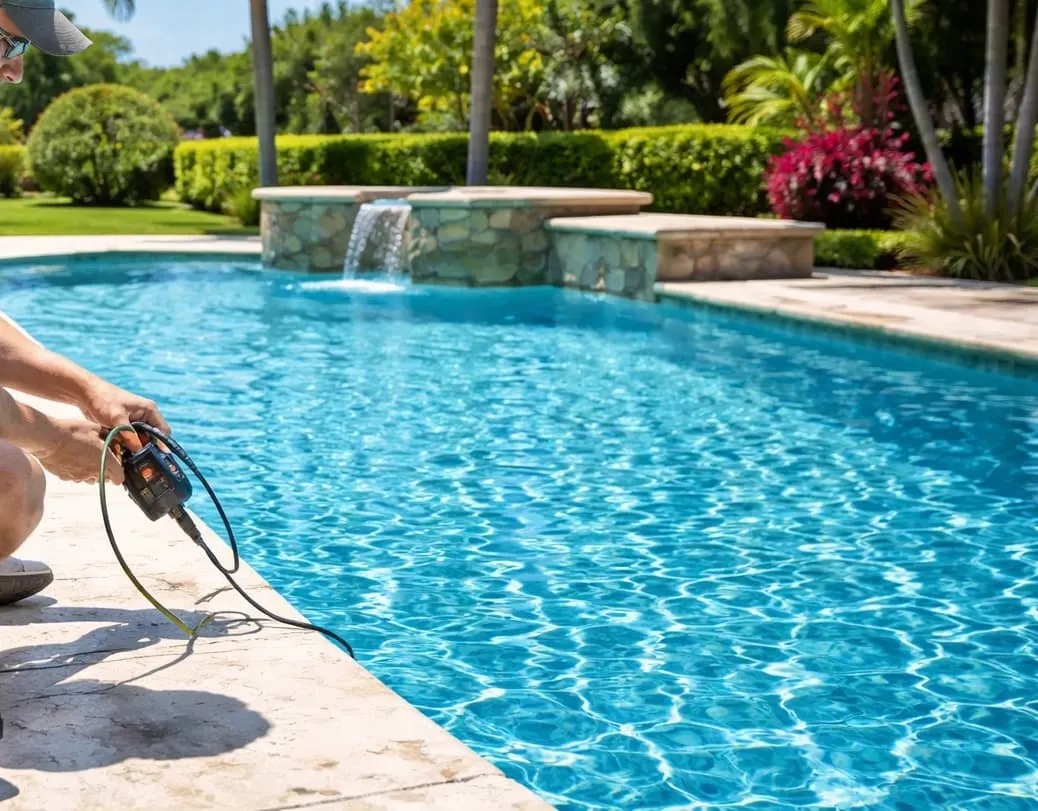
If your pool keeps dropping after you account for heat, wind and splash-out, you may need pool leak detection in Houston, TX. The fastest way to find out is a bucket test, followed by a look at the equipment and fittings. If the pool loses more water than a bucket sitting beside it, something is likely escaping, and our pool leak detection service is built to find where.
Check whether water loss is more than evaporation
Every outdoor pool loses some water to evaporation. Houston heat, humidity swings and wind all change how much. The question is whether your pool is losing more than the weather explains.
Run a bucket test
- Fill a bucket with pool water, leaving a few inches of space at the top.
- Set it on a pool step so the water inside the bucket sits at about the same level as the pool outside.
- Mark the water level inside the bucket and the pool level outside it with tape or a waterproof marker.
- Leave both alone for a day. Do not add water and keep swimmers out if you can.
- Compare the two marks.
Both the bucket and the pool see the same sun and wind. If the pool level fell noticeably farther than the bucket level, evaporation does not account for the difference.
Repeat it with the equipment off
Run the test once with the pump running and once with it off, and write down what happened each time. If the loss is bigger while the pump runs, the leak may be on the pressure side, such as a return line. If the loss is bigger with the pump off, a leak in the shell or a fitting is a more likely suspect. Treat this as a clue, not a verdict, since the numbers are rough.
Look for signs around the pool and equipment
Walk the pool and the equipment pad with a notepad. Leaks often show up as small oddities long before the water line drops by much.
- Damp or soft ground near the equipment pad or along the plumbing runs when it has not rained.
- Gaps or cracks around the skimmer, returns, lights or the tile line.
- A pump that loses prime, pulls in air or runs rough.
- An auto-fill valve that runs more often than it used to.
- Algae that keeps coming back even when chemistry is balanced, or chemicals that seem to disappear fast.
- Cracks, loose tile or a pool deck that has shifted or sunk in one area.
Try a dye test on a suspected spot
With the pump off and the water still, squeeze a small amount of leak-detection dye near a crack, fitting or skimmer throat. If the dye drifts steadily toward the opening instead of dispersing, water is probably moving through it. A dye test only checks spots you can reach and see, so a clean result does not rule out a leak in buried plumbing or under the shell.
How evaporation and a leak usually compare
| What you notice | Points to evaporation | Points to a leak |
|---|---|---|
| Bucket test | Pool and bucket drop about the same | Pool drops clearly more than the bucket |
| Pattern | Steady loss that tracks hot, dry or windy days | Loss continues on calm, cool days |
| Level stops dropping | Rarely, it follows the weather | Sometimes the level stops at a certain height, which can mark the leak location |
| Around the equipment | Dry ground and no air in the pump | Wet spots, air in the pump or a busy auto-fill |
What pool leak detection can narrow down
Guessing from the water level alone can lead to the wrong repair. A professional detection visit checks the shell, the fittings and the plumbing to find where water is actually escaping. That may include pressure testing the lines, inspecting skimmers, returns, lights and drains, and looking for cracks or failed seals in the shell.
Finding the leak location also tells you what kind of fix you need. A failed fitting seal, a cracked line and a crack in the shell are very different jobs with different costs and timelines. Once we know the source, we can explain the options and move on to pool leak repair with a clear target instead of opening up the deck or shell in several places.
Houston area conditions and a practical next step
Gulf Coast summers usually run long, hot and humid, so evaporation is high from June through September and a small drop is normal. Winters are generally mild, though cold snaps can show up in January and February. Cooler weather and wind change how fast the water evaporates, so a bucket test in a windy week can look different from one in a still, humid week. Heavy rain, which can come with tropical storms between June and November, can also push the level up and hide a slow leak, so test after the pool settles and the water is back to normal.
These conditions apply across Houston, Spring and Pasadena, and we also work with pool owners in places like Cypress, Baytown and Friendswood. If your yard has clay soil, dry spells and wet spells can move the ground around the pool and its plumbing, which is one more reason to take steady water loss seriously.
Record the water level each day for a week, note whether the equipment was running, and run the bucket test at least twice. If the loss continues beyond what the bucket shows, call us for pool leak detection. We offer a Free Estimate.
Common questions
How can I tell if my pool is leaking or evaporating?
Run a bucket test. If the pool level drops farther than the water in a bucket placed on a step, evaporation alone is not the cause. Repeat the test with the pump on and off to get more clues.
Does pool leak detection work for pools in Spring, TX?
Yes. We handle pool leak detection for owners in Spring as well as Houston and Pasadena, and the checks cover the shell, fittings and plumbing.
Should I keep adding water while I wait for a leak check?
Yes, keep the pool at a safe operating level so the pump does not run dry. Just note when you add water and how much the level drops between top-offs so the pattern is clear.
Areas we serve
Our services
Have a question about your project? Call (713) 245-9845